Trinity Mount Ministries

Showing posts with label legislation. Show all posts

Thursday, June 11, 2026

The Growing Threat: An Updated Look at AI-Generated CSAM and Global Efforts to Combat It (June 2026)


By Brett Fletcher

​As we navigate the middle of 2026, the digital landscape has evolved rapidly, bringing unprecedented challenges to the fight against online child sexual abuse material (CSAM). The most significant development in recent years is the proliferation of AI-generated CSAM—content created or altered using sophisticated generative AI tools. This technology has not only complicated detection and enforcement but has also introduced profound new dimensions of trauma for victims.

​This blog entry provides an updated assessment of this growing threat, the corresponding surge in law enforcement initiatives, the resulting bipartisan legislative action, and the organizations leading the charge to protect the world's children.

​The New Frontier of CSAM: AI Generation

​The landscape has changed dramatically since the early 2020s. While traditional CSAM (capturing real-world abuse) remains a primary concern, AI-generated content has exploded. This category now includes:

  • Entirely Synthetic CSAM: Realistic depictions of children created by AI models trained on vast datasets, including, tragically, existing CSAM.
  • "Deepfake" CSAM: Altering existing content to place real children’s likenesses onto abusive scenarios. This is frequently used for online harassment and extortion, known as sextortion.

​This evolution presents unique challenges. Unlike traditional CSAM, synthetic material can be generated in unlimited quantities on consumer-grade hardware. It tests the boundaries of existing visual hash-based detection systems and often exists in a complex legal area regarding creation versus possession.

​Law Enforcement’s Tech-Forward Response

​Law enforcement agencies globally have shifted their strategies to address this AI threat. Investigative units are no longer just looking for stored digital files; they are dismantling the infrastructure supporting the creation and dissemination of synthetic abuse material.

​Specialized units, such as the FBI’s Crimes Against Children (CAC) task forces and Europol's European Cybercrime Centre (EC3), have increasingly adopted AI themselves—using it to automate the detection of new synthetic content and to trace the "digital fingerprints" of specific generative models. Forensic teams utilize high-tech mobile workstations and dedicated labs to track digital exploitation across encrypted networks.

​Bipartisan Legislative Action: New Laws for a New Threat


​One of the few areas to maintain strong, consistent bipartisan support in 2026 is the protection of children online. Recognizing that existing statutes drafted in the early internet era were insufficient for the AI age, legislatures around the world have passed sweeping new laws. This push for safety has successfully united lawmakers across opposing political spectrums, driving collaborative policy and swift legislative changes.

Key Legislative Shifts in 2026:

  • Explicit Criminalization: New laws explicitly classify the generation and distribution of AI-generated CSAM (including deepfakes of real minors) as felonies, independent of whether a real child was physically abused in the specific creation of that image.
  • Platform Accountability: Stronger 'duty of care' regulations hold technology platforms accountable for failing to prevent their generative AI tools from being used to create CSAM, and for failing to expeditiously remove such content.
  • Mandatory Reporting: Updated laws have expanded mandatory reporting requirements for AI service providers who detect CSAM being generated using their systems.

​The Mental and Emotional Health Toll

​It is critical that we always ground these discussions in the human cost. The victim of CSAM—whether real or deepfaked—suffers profound harm. We are seeing a measurable increase in acute emotional distress directly linked to the AI threat.

​For real children whose images are used for deepfakes, the trauma is unique. They describe a terrifying loss of agency, knowing their likeness can be manipulated and distributed infinitely. The emotional health of these children often shows:

  • Skyrocketing Anxieties: A constant fear of detection, social ostracization, and future blackmail.
  • Deep Depression: Feelings of helplessness and worthlessness, particularly when AI content cannot be fully erased from the internet.
  • PTSD Symptoms: Flashbacks and severe emotional reactivity to digital environments.

​A synthetic image can create very real devastation. The mental health support systems available to these victims are under significant strain and must be expanded.

​Key Organizations Combatting the Attack

​We must highlight the vital organizations that provide infrastructure, advocacy, and direct support to both law enforcement and victims. Their work is the backbone of the global response.

  • Internet Watch Foundation (IWF): Based in the UK, the IWF operates a global hotline for reporting CSAM, working directly with the internet industry to remove content.
  • NCMEC (National Center for Missing & Exploited Children): Based in the US, NCMEC operates the CyberTipline, the centralized reporting mechanism for CSAM. They process millions of tips, analyze content, and assist law enforcement globally.
  • ICMEC (International Centre for Missing & Exploited Children): ICMEC works across borders to advocate for better laws, train law enforcement, and build capacity to fight child exploitation worldwide.

​Contact Information: Reporting CSAM and Seeking Help

​If you encounter CSAM, have information about child exploitation, or if you or someone you know needs help, please use the contacts below. Do not download, save, or share any suspected CSAM; report the link immediately.

​Worldwide / Reporting Hotlines:

  • CyberTipline (NCMEC):
    • ​Website: www.cybertipline.org
    • Note: This is the primary reporting point for most of the world.
  • Internet Watch Foundation (IWF):
  • INHOPE Network (Global Association of Hotlines):

​Law Enforcement Agencies (United States):

  • Federal Bureau of Investigation (FBI):
    • ​Phone: 1-800-CALL-FBI (1-800-225-5324)
    • ​Online Tips: tips.fbi.gov
  • Immigration and Customs Enforcement (ICE) HSI Tip Line:
    • ​Phone: 1-866-DHS-2-ICE (1-866-347-2423)

​Victim Support & Mental Health (United States):

  • Crisis Text Line: Text HOME to 741741
  • 988 Suicide & Crisis Lifeline: Call or text 988

​The fight against AI-generated CSAM requires global collaboration, technical innovation, strong laws, and a compassionate focus on the survivors. The updated framework of 2026 provides powerful new tools, but vigilance remains essential.


Saturday, March 8, 2025

New report urges legislation to address addictive social media algorithms harming children

 BRIANNA KRAEMER

The North Carolina Department of Health and Human Services has advised lawmakers to take action against addictive social media algorithms that officials say are harming youth mental health across the state.

The Child Fatality Task Force released its 2025 annual report this week, offering recommendations on how the governor and the General Assembly can create policies they say will save lives. The report offers 11 recommendations that address a range of issues that threaten child health and safety, including teens spending an average of 3.5 hours per day on social media.

“Frequent social media use may be associated with changes in the developing brain,” the report reads. “Youth who spend more than three hours a day on social media face double the risk of poor mental health.”

According to DHHS, one-quarter of adolescents perceive that they are “moderately” or “severely” addicted to social media. Data shows 78% of 13- to 17-year-olds report check their devices hourly and 46% check almost constantly (compared to 24% in 2018).

Social media use can interfere with sleep, and poor sleep is linked to physical and mental health issues, risky behaviors, poor school performance, and altered brain development. Many experts and national organizations are expressing concern and issuing advisories about the impact of social media on youth mental health.

“Children and adolescents on social media are commonly exposed to extreme, inappropriate, and harmful content, and those who spend more than 3 hours a day on social media face double the risk of poor mental health including experiencing symptoms of depression and anxiety,” stated a US Surgeon General’s Advisory.

House Bill 644 was introduced in 2023 to combat social media addiction. Though it had bipartisan support, it failed to garner substantial action in the House.

Other proposals include more spending to increase the number of school nurses, social workers, counselors, and psychologists. To address firearm safety, the DHHS officials call for recurring funding of $2.16 million for the NC S.A.F.E. Campaign, which educates the public about safe firearm storage. In his previous role as North Carolina’s attorney general, Stein targeted social media platforms multiple times.

In 2024, Stein joined 12 other states in suing TikTok, alleging it was purposely designed to keep children addicted. In October 2023, Stein and more than 40 other bipartisan attorneys sued Meta, which owns Facebook and Instagram, alleging a similar claim that the platforms were purposefully designed to be addictive to children.

While the report endorses legislation targeting addictive social media algorithms, officials provide additional recommendations to address youth suicide, promote mental health, and prevent firearm deaths and injuries among children. 

The full list of legislative recommendations from the Child Fatality Task Force are:

  • Raise the legal age for tobacco product sales from 18 to 21 and require licensing for retailers.
  • Prevent child access to intoxicating cannabis by regulating sales, packaging, and retailer permits.
  • Increase investment in early child care, including child care subsidies.
  • Fund more school nurses, social workers, counselors, and psychologists.
  • Address addictive algorithms in social media that harm children.
  • Provide $2.16 million for the NC S.A.F.E. firearm safe storage campaign.
  • Strengthen firearm storage laws to protect minors.
  • Funding to prevent sleep-related infant deaths.
  • Fund Medicaid reimbursement for doula services throughout pregnancy and postpartum.
  • Legislation for Fetal and Infant Mortality Reviews (FIMR).
Update child passenger safety laws to reflect best practices.


Saturday, June 8, 2019

Catholic Church spent $10.6 million to lobby against legislation that would benefit victims of child sex abuse


BY CHRISTINA CAPATIDES

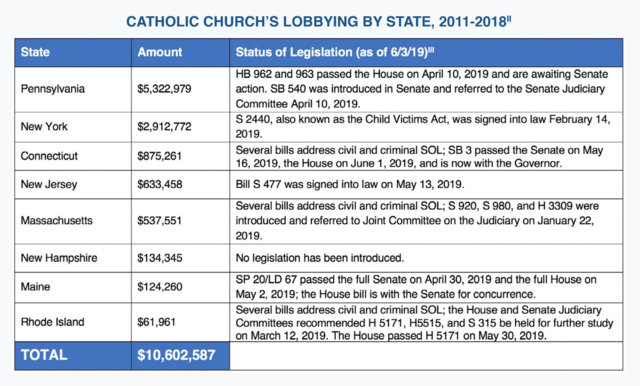
A new report released Tuesday reveals that, over the past eight years, the Catholic Church has spent $10.6 million in the northeastern United States to fight legislation that would help victims of clergy sexual abuse seek justice.

"At the most basic level, we were inspired by frustration," says attorney Gerald Williams, a partner at Williams Cedar, one of four law firms that jointly commissioned the report. "We represent hundreds of people, who have truly been victimized by clergymen in the Catholic Church. We've heard a lot about the church's desire to be accountable and turn over a new leaf. But when we turn to the form where we can most help people and where we can get the most justice — the courts of justice — the church has been there blocking their efforts."

In New York, for example, the Catholic Church spent $2,912,772 lobbying against the Child Victims Act, which Governor Andrew Cuomo ultimately signed into law on February 14, 2019. The act gives survivors more time to seek justice against their abusers, increasing the age at which victims are able to sue from 23 to 55.

Similarly, in Pennsylvania — where in 2018 a grand jury report detailed evidence of more than 300 priests credibly accused of sexually abusing more than 1,000 children — the Catholic Church spent $5,322,979 lobbying to keep current restrictions in place on the statute of limitations in which victims can seek criminal or civil charges against their abusers.

church-influencing-state.png
The report, CHURCH INFLUENCING STATE: How the Catholic Church Spent Millions Against Survivors of Clergy Abuse, was commissioned by Seeger Weiss LLP, Williams Cedar LLC, Abraham Watkins and the Simpson Tuegel Law Firm and is believed to be the most comprehensive analysis of the Church's campaign to fight statute of limitations legislation. COURTESY WILLIAMS CEDAR LLC

The funneling of such a large chunk of money to the Church's lobbying arm, the Catholic Conference Policy Group, with the intention of combating reform that would benefit sexual abuse victims seems directly counter to recent statements the Church has made publicly, vowing to take accountability.
In August 2018, Pope Francis himself said, "The pain of the victims and their families is also our pain, and so it is urgent that we once more reaffirm our commitment to ensure the protection of minors and of vulnerable adults."
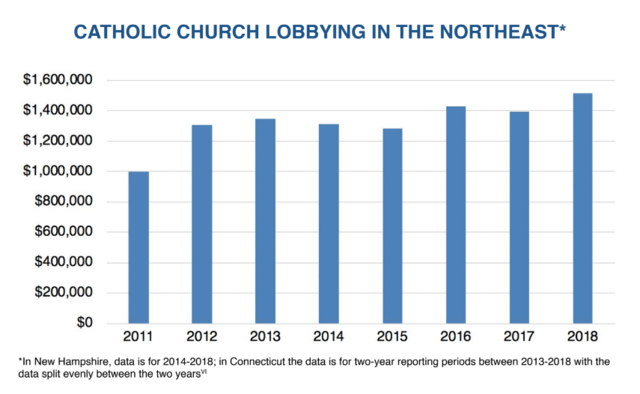
However, according to the report, "CHURCH INFLUENCING STATE: How the Catholic Church Spent Millions Against Survivors of Clergy Abuse," the Catholic Church has not only continued to invest in lobbying against the interests of victims, their investments in this area have actually increased over the years.


church-influencing-state2.png
"CHURCH INFLUENCING STATE" / COURTESY WILLIAMS CEDAR LLC

"They make a lot of positive statements, but when the Churchliterally puts its money where its mouth is, it's on the side of self-protection and not help for the survivors," Williams told CBS News. "I believe the church has a long way to go to show that it stands with survivors. I believe that these data indicate that it's not standing with the survivors, that in fact it's standing against the survivors."
The data in the report is based entirely on public filings in the individual states of Connecticut, Maine, Massachusetts, New Hampshire, New Jersey, New York, Pennsylvania and Rhode Island. And Williams believes it's "likely" that at least some of the money used by the Catholic Church to combat extending the statute of limitations for survivors came from Sunday collections from the faithful.
"It's hard for us to tell just from the raw numbers, but it's likely," he says. "We can't say for certain where the money comes from. We can only say that it's a lot of money that could be spent for more constructive purposes."
Every proposed amendment detailed in the report would benefit all victims of child sex abuse, not only those abused at the hands of the Church. And yet, more than $10 million of the Catholic Church's money has now gone to fighting statute of limitation extensions for those victims, as well.
"I hope, frankly, that Catholics who come across this report take away from it the same thing that I take away from it, as a Catholic born-and-raised person myself," Williams told CBS News. "I had 16 years of Catholic education. Catholicism teaches a lot of important and noble values, but the institution has really acted in ways contradicting those values. So, what I take away from this are really two emotions: sadness and anger. The sadness is a little stronger even than the anger. But maybe if Catholics themselves get angry about this, then maybe the institution itself will change… It just has to change. And that has to start with members of the church."
At the time of this article publishing, neither the U.S. Conference of Catholic Bishops, nor the Archdiocese of New York had responded to CBS News' request for comment.

Thursday, March 7, 2013

House of Representatives approve legislation to formulate statewide missing child alert system

OKLAHOMA CITY – Legislators have unanimously approved a bill that is anticipated to expedite the recovery of missing children and runaways through establishing the JaRay Wilson Runaway Child Alert System.

Under House Bill 2227, which was approved 94-0 by the House of Representatives Wednesday afternoon, a child alert system would be created across the state of Oklahoma. The system would be activated once a law enforcement agency receives the report of the missing child and verifies its accuracy.

READ THE BILL (http://bit.ly/169yFOQ)

Families of the missing child will be asked to provide a photograph for statewide and nationwide distribution. Child alerts would also be reported immediately to the national crime information center.

Rep. Joe Dorman, who authored the bill, said locals families have communicated to him their frustration with the current system's lack of efficiency.
Dorman worked with the Department of Public Safety, the Oklahoma Bureau of Narcotics and the Office of Juvenile Affairs in order to formulate the language of the bill in the most effective way, he said Wednesday.

An amendment made by co-author Rep. Harold Wright named the alert system after JaRay Wilson, a missing teenager believed to be a victim of human trafficking.
The bill will be sponsored by Sen. Mike Schulz, R-Altus, as it advances to the state Senate.

Read more:
http://www.kjrh.com/dpp/news/state/house-of-representative-approves-legislation-to-formulate-statewide-missing-child-alert-system