Trinity Mount Ministries

Showing posts with label Report CSAM. Show all posts

Wednesday, May 13, 2026

Protecting Children in the Age of Generative AI: A Blueprint for Action

By Brett Fletcher 

​Generative AI (GenAI) is transforming our world, offering incredible opportunities for innovation. However, this technology also presents new and complex challenges, especially concerning online child safety. A critical new blueprint, "Protecting Children in the Age of Generative AI," outlines a comprehensive framework to address the misuse of GenAI to facilitate child sexual abuse material (CSAM) and exploitation.

​This blueprint represents a significant step forward, aligning the efforts of technology providers, law enforcement, and advocacy groups.

​Foreword from Leadership

​The blueprint is introduced by State Attorneys General Jeff Jackson (North Carolina) and Derek Brown (Utah), Co-Chairs of the Attorney General Alliance's AI Task Force. They emphasize the need for proactive, adaptive strategies:

​"We are particularly encouraged by the framework's recognition that effective GenAI safeguards require layered defenses — not a single technical control, but a combination of detection, refusal mechanisms, human oversight, and continuous adaptation to emerging misuse patterns... Getting the prevention architecture right upstream is the single highest-leverage investment the industry can make in child safety."


​Karen White, Executive Director of the Attorney General Alliance, and Michelle DeLaune, President & CEO of the National Center for Missing & Exploited Children (NCMEC), also applauded the initiative, stressing the importance of collaboration across all sectors to reduce harm and support children's safety.

​The Evolving Threat

​While digital services have unfortunately long been misused by bad actors, generative AI introduces specific new dynamics that strain existing legal and investigative systems. These threats include:

  • Synthetic CSAM: AI can be used to create realistic, entirely synthetic depictions of abuse without a direct victim.
  • Digital Alteration: Existing imagery can be easily manipulated.
  • Scale and Speed: Offenders can operate more efficiently across different content formats (text, image, video).

​The Policy Blueprint: Three Reinforcing Priorities

​The framework advanced in this document focuses on three mutually reinforcing pillars designed to cover the full lifecycle of harm—from prevention and detection to investigation and prosecution.

​Priority One: State Legislative Modernization

​The goal is to ensure that state laws remain fully enforceable and effective as technology evolves. Key recommendations include:

  • Updating CSAM Definitions: Explicitly covering AI-generated and digitally altered material.
  • Clarifying Attempt Liability: Ensuring that intentional attempts to generate abusive material remain prosecutable, even if safeguards block the output.
  • Establishing Good-Faith Safe Harbors: Protecting providers who conduct responsible detection, reporting, and safety research from unintended liability.

​According to research cited in the blueprint, as of August 2025, 45 states have already enacted laws addressing AI-generated or computer-edited CSAM, underscoring widespread legislative concern.

​Priority Two: Best Practices for Provider Reporting & Coordination

​This section aims to improve the quality and actionability of reports made to NCMEC’s CyberTipline. Recommendations include:

  • High-Quality, Structured Reports: Providing complete details (Who, What, Where, When) rather than just file excerpts.
  • AI-Assisted Triage with Human Review: Using AI to surface high-risk activity but maintaining human oversight for reporting decisions.
  • Reducing Investigative Burden: Bundling reports by user or incident and including technical identifiers (hashes, IP port numbers) to connect related activity quickly.

​Priority Three: Safety-by-Design Prevention & Detection Safeguards

​The most effective way to protect children is to interrupt exploitation attempts before harm occurs. The blueprint calls for:

  • Intent Detection: Detecting high-risk prompts and behavioral patterns.
  • Generation Refusal: Systems must actively refuse prohibited requests and implement intervention mechanisms (like friction or throttling).
  • Continuous Risk Monitoring: Regularly evaluating and adapting safeguards to address emerging misuse patterns.


​Conclusion

​Protecting children online is a shared responsibility. The rise of generative AI demands updated legal frameworks, improved reporting mechanisms, and robust safety safeguards built directly into the technology. This blueprint provides the roadmap for government, law enforcement, non-profits, and the tech industry to collaborate effectively and ensure innovation supports child safety.


Friday, May 8, 2026

PROJECT SAFE CHILDHOOD - DOJ - Trinity Mount Ministries - UPDATE - 05/13/2026

Help Find Missing Children. Let's Put An End To Child Abuse And Exploitation... Care.

PROJECT SAFE CHILDHOOD

Project Safe Childhood

  
About Project Safe Childhood

Project Safe Childhood is a nationwide initiative to combat the growing epidemic of child sexual exploitation and abuse launched in May 2006 by the Department of Justice.  Led by the U.S. Attorneys' Offices and the Criminal Division's Child Exploitation and Obscenity Section (CEOS), Project Safe Childhood marshals federal, state and local resources to better locate, apprehend and prosecute individuals who exploit children via the Internet, as well as to identify and rescue victims.

Learn More About Project Safe Childhood

CyberTipline - NCMEC - Trinity Mount Ministries - REPORT CHILD ABUSE! REPORT CSAM! 1-800-843-5678


2024 marked 40 years of operation for the National Center for Missing & Exploited Children. Over the past four decades, NCMEC has continuously confronted evolving threats against children and worked with law enforcement, legislators, industry, survivors and their families and others to create and implement solutions to keep children safe online.


NCMEC's CyberTipline was created in 1998 to receive reports of suspected child sexual exploitation from the public and electronic service providers (ESPs). Through this work, we support law enforcement efforts to stop child sexual exploitation and abuse and provide services to combat the harmful circulation of child sexual abuse material (CSAM).


This report includes data from reports made to the CyberTipline in 2024 and reflects the ever-changing nature of the threats against children and the landscape of online child protection.


2024 CyberTipline Reports by Electronic Service Providers (ESP) illustration
CyberTipline Media Coverage Success StoriesDownload PDF

Skip to main co         

                  Overview

NCMEC’s CyberTipline is the nation’s centralized reporting system for the online exploitation of children. The public and electronic service providers can make reports of suspected online enticement of children for sexual acts, child sexual molestation, child sexual abuse material, child sex tourism, child sex trafficking, unsolicited obscene materials sent to a child, misleading domain names, and misleading words or digital images on the internet.

Every child deserves a safe childhood.

What Happens to Information in a CyberTip?

NCMEC staff review each tip and work to find a potential location for the incident reported so that it may be made available to the appropriate law-enforcement agency for possible investigation. We also use the information from our CyberTipline reports to help shape our prevention and safety messages.

Is Your Image Out There?

Get Support

One of the worst things about having an explicit image online is feeling like you’re facing everything alone. But you have people who care for you and want to help. Reach out to them!

A trusted adult can offer advice, help you report, and help you deal with other issues. It could be your mom, dad, an aunt, a school counselor, or anyone you trust and are comfortable talking to. You can also “self report” by making a report on your own to the CyberTipline.

Families of exploited children often feel alone in their struggle and overwhelmed by the issues affecting their lives. NCMEC provides assistance and support to victims and families such as crisis intervention and local counseling referrals to appropriate professionals. Additionally, NCMEC’s Team HOPE is a volunteer program that connects families to others who have experienced the crisis of a sexually exploited child.

Don't Give Up

Having a sexually exploitative image of yourself exposed online is a scary experience. It can make you feel vulnerable and isolated, but remember, others have been in the same situation as you – and they’ve overcome it. Learn the steps you can take to limit the spread of the content.

By the Numbers

In 2023, reports made to the CyberTipline rose more than 12% from the previous year, surpassing 36.2 million reports.

There were 105,653,162 data files reported to the CyberTipline in 2023.

Reports of online enticement increased by more than 300% from 44,155 in 2021 to 186,819 in 2023. 

Find more data in the CyberTipline Report.

By the Numbers

In 2022:

Find more data in the CyberTipline Report.

More

Learn more about online exploitation and safety.
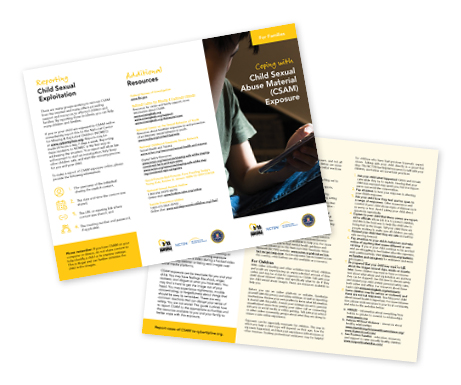
Coping with Child Sexual Abuse (CSAM) Exposure For Families

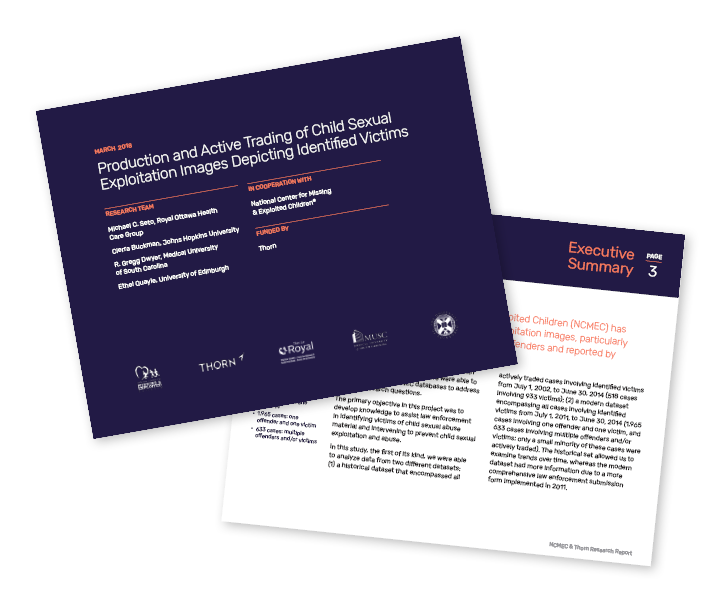
Production and Active Trading of Child Sexual Exploitation Images Depicting Identified Victims
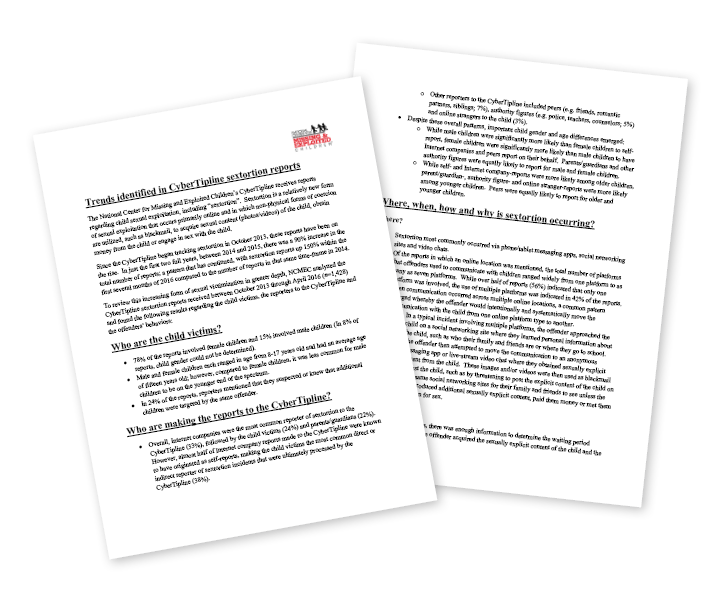
Trends Identified in CyberTipline Sextortion Reports

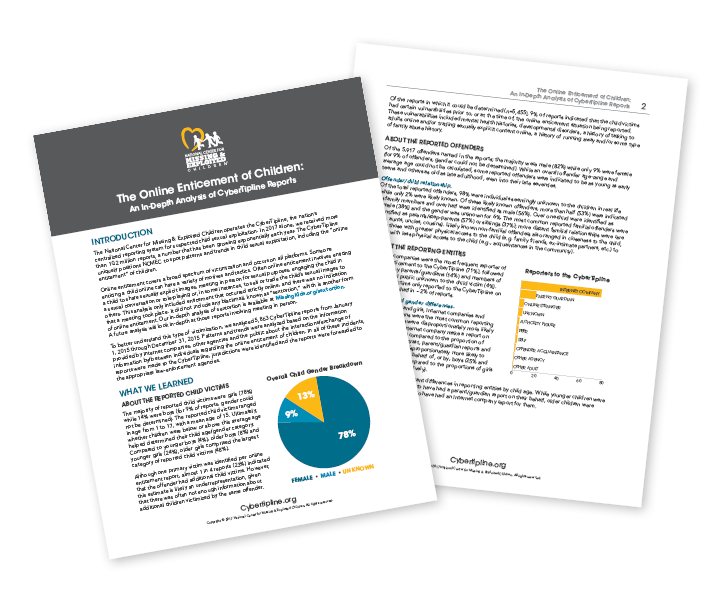
The Online Enticement of Children: An In-Depth Analysis of CyberTipline Reports


National Center for Missing and Exploited Children, CyberTipline, 1-800-843-5678

Report It

If you think you have seen a missing child, or suspect a child may be sexually exploited, contact the National Center for Missing & Exploited Children 24 hours a day, 7 days a week.

Report Child Sexual Exploitation

Use the CyberTipline to report child sexual exploitation.

Make a CyberTipline Report »

The banner is a tool to allow you to conveniently share a link to NCMEC's CyberTipline to create a report. To display this banner on your website:

  • Read the terms of use. Your use of any National Center for Missing & Exploited Children® banner signifies your agreement to these terms of use.
  • Enter the code snippet below into your site.

<iframe src="https://www.missingkids.org/gethelpnow/cybertipline/widget" width="300" height="500"></iframe>


NCMEC is a founding member of



Trinity Mount Ministries - NCMEC - AMBER Alerts - Active Missing Children Posters - UPDATE - 05/12/2026

Help Find Missing Children. Let's Put An End To Child Abuse And Exploitation... Care.


Active Missing Children Posters Below.

Active AMBER Alerts
NameMissing FromIssued ForAlert Date
Allen FischerMonteview, IDIDJun 23, 2025
Rachelle FischerMonteview, IDIDJun 23, 2025

Active AMBER Alert cases will remain on this page updated to 6 months from activation.  Following that, active missing child posters can be found by using the search tool 
here.

Notice: The National Center for Missing & Exploited Children® certifies the posters on this site only if they contain the NCMEC logo and the 1-800-THE-LOST® (1-800-843-5678) number. All other posters are the responsibility of the agency whose logo appears on the poster.