Trinity Mount Ministries

Showing posts with label Report Child Exploitation. Show all posts

Friday, June 26, 2026

Law Enforcement Steps Up: 6 Arrested in World Cup Human Trafficking Sting


While the world turns its attention to the excitement of the FIFA World Cup, law enforcement agencies in our region are focusing on a much darker reality. Major international sporting events bring incredible economic and cultural energy to host communities, but they also unfortunately create a breeding ground for traffickers looking to exploit vulnerable individuals.

​In response, a massive multi-agency task force recently launched Operation “Red Card,” a proactive enforcement sting aimed directly at human trafficking, child exploitation, and commercial sex acts.

​The Rhode Island State Police, alongside local and federal partners, announced the arrest of six individuals connected to the operation.

​The Arrests and Charges

​The ongoing investigation has led to major charges ranging from solicitation to federal-level child exploitation. Here is who was arrested:

  • Richard Lallier (34, Rehoboth, MA): Arraigned in US District Court and held without bail. Charged with Federal Attempted Enticement, Attempted Interstate Travel for Sexual Contact with a Minor, and Attempted Transmission of Obscene Material to a Minor.
  • Joshua Lincoln (27, North Providence, RI): Released on personal recognizance. Charged with Indecent Solicitation of a Minor and Electronically Disseminating Indecent Material to a Minor.
  • Jacob Palazzo (26, Cranston, RI): Released on personal recognizance. Charged with Indecent Solicitation of a Minor.
  • Franco Miccoli (60, Johnston, RI): Released on personal recognizance. Charged with Procurement of Sexual Conduct for a Fee.
  • Travis Shaw (38, Tiverton, RI): Released on personal recognizance. Charged with Electronically Disseminating Indecent Material to a Minor.
  • Rocky Joseph (38, Central Falls, RI): Released on personal recognizance. Charged with Electronically Disseminating Indecent Material to a Minor.

​Spotting the Signs and Taking Action

​Human trafficking isn't always hidden away in the shadows—it frequently happens right in plain sight. Authorities urge all of us to stay vigilant. Keep an eye out for individuals who appear to be heavily controlled, coerced, or who aren't allowed to speak freely for themselves.

​If you see something that doesn't feel right, do not hesitate to speak up. You can contact local law enforcement directly or reach out to the National Human Trafficking Hotline. It is completely confidential, free, and available 24/7.

​Agency Contacts & Resources

​Operation "Red Card" was made possible through the joint coordination of several state and federal agencies. For more information, media inquiries, or to report a crime, you can reach out to them below:

  • Rhode Island State Police (RISP)
    • Contact: Major Kenneth Moriarty – 401-764-5604
    • Address: 311 Danielson Pike, North Scituate, RI 02857
    • Website: risp.ri.gov
  • Federal Bureau of Investigation (FBI) - Boston Field Office
  • Massachusetts State Police (MSP)
  • Rhode Island Office of the Attorney General
  • U.S. Attorney's Office - District of Rhode Island
  • Naval Criminal Investigative Service (NCIS)

Thursday, June 18, 2026

Anatomy of a Hoax: Why Fake Exploitation Stories Look So Real

By Brett Fletcher

​The internet is increasingly flooded with hyper-detailed, dramatic accounts of major human trafficking raids that never actually happened. Stories like the fictional "Aqua Kingdom Resort" raid contain all the hallmarks of a viral true-crime exposé: specific dates, tactical timelines, financial figures, and named defendants.

​When these fictional scenarios or internet rumors strip away their "creative writing" or "roleplay" labels, they spread rapidly because they exploit specific psychological and structural triggers. Here is a breakdown of how these fabrications mirror reality to deceive readers.

​1. The Use of "Hyper-Real" Technical Details

​The most convincing fake stories don't rely on vague claims; they use precise logistical mechanisms that make the narrative feel authentic.

  • The Flaw in the System: Authors often introduce a clever, micro-level detail—such as a sharp-eyed employee noticing a retired wristband color—to give the story an emotional anchor and a "hero" element.
  • Regulatory Loopopholes: Mentioning specific bureaucratic processes, like exploiting city renovation permits or fabricating cross-state foster program paperwork, makes it sound as though the writer has inside access to an official investigative brief.
  • Complex Financial Siphoning: Throwing out specific dollar amounts ($8–12 million) layered through multi-state shell companies mirrors the actual, sophisticated financial crimes that federal task forces track, instantly elevating the story's credibility.

​2. Emotional Exploitation and Algorithmic Velocity

​Stories involving the endangerment and rescue of children trigger our deepest, most visceral protective instincts.

  • The Outrage Cycle: When a reader encounters a story that causes immediate horror or outrage, the natural human reaction is to share it to raise awareness or protect others.
  • Rewarding the Shock Factor: Social media algorithms prioritize high-engagement content. Because these stories provoke intense emotional reactions, platforms push them to the top of user feeds, creating a snowball effect before anyone checks the facts.

​3. Shifting Focus: The Real Danger of Fake Narratives

​While spreading awareness feels like the right thing to do, unverified hoaxes create significant roadblocks for real-world child advocacy:

  • Resource Depletion: When a fictional story names a specific location or business, it can lead to a flood of panicked calls to local law enforcement, tying up phone lines and investigative resources that should be spent on active cases.
  • Desensitization: A constant barrage of sensationalized, movie-plot style stories can desensitize the public to the quieter, more common signs of real-world exploitation happening in local communities.
  • How to Verify Before You Share: Real federal actions, multi-state indictments, and major rescues are always accompanied by public records. Before sharing a shocking case update, check official channels like the FBI National Press Room, the Department of Justice (DOJ) Briefing Room, or official alerts from the National Center for Missing & Exploited Children (NCMEC). If it isn't there, treat it as fiction.

    The Legal Gray Area: Why Isn't Fabrication Illegal?

    ​When encountering a deeply disturbing, completely fabricated account of child exploitation, the immediate and natural human reaction is outrage: How can anyone get away with making this up?

    ​The legal reality is highly complex, largely due to how constitutional law balances free speech against actionable public harm. In the United States, creating fictional narratives—even highly realistic and unsettling ones—is generally protected under the First Amendment, unless it crosses very specific legal boundaries:

    • Defamation and Libel: If a fake story names a real living person or an operating business and falsely accuses them of a heinous crime, it crosses a definitive legal line. The targeted individual or entity can file a massive civil lawsuit for the catastrophic damage done to their reputation.
    • Falsely Reporting a Crime: Intentionally contacting law enforcement with a fabricated story, or intentionally orchestrating an active, immediate public panic (such as a false bomb threat or active shooter hoax), is strictly illegal and carries severe criminal penalties.

    ​The Loophole of Complete Fiction

    ​The creators of viral internet hoaxes often evade legal consequences by using entirely fictional entities. In the "Aqua Kingdom Resort" scenario, the writer used a fake business name and a fictional defendant name ("Garrett Aldren").

    ​Because no real individual's reputation was legally defamed, and because the text was posted to the internet rather than called in as an emergency report to a police dispatcher, it legally falls under the umbrella of "creative fiction" or online rumor—no matter how closely it mimics an official government press release.

    ​The Ethical Toll on Real-World Advocacy

    ​While it may bypass legal penalties, the ethical impact of these fabrications is devastating. Child safety advocacy relies entirely on public trust and swift, accurate communication. When the digital landscape is cluttered with hyper-sensationalized, movie-plot style fabrications, it creates a dangerous "cry wolf" effect.

    ​The public risks becoming desensitized, making it significantly harder for legitimate agencies to command attention when real, urgent alerts are issued.

Wednesday, May 13, 2026

Protecting Children in the Age of Generative AI: A Blueprint for Action

By Brett Fletcher 

​Generative AI (GenAI) is transforming our world, offering incredible opportunities for innovation. However, this technology also presents new and complex challenges, especially concerning online child safety. A critical new blueprint, "Protecting Children in the Age of Generative AI," outlines a comprehensive framework to address the misuse of GenAI to facilitate child sexual abuse material (CSAM) and exploitation.

​This blueprint represents a significant step forward, aligning the efforts of technology providers, law enforcement, and advocacy groups.

​Foreword from Leadership

​The blueprint is introduced by State Attorneys General Jeff Jackson (North Carolina) and Derek Brown (Utah), Co-Chairs of the Attorney General Alliance's AI Task Force. They emphasize the need for proactive, adaptive strategies:

​"We are particularly encouraged by the framework's recognition that effective GenAI safeguards require layered defenses — not a single technical control, but a combination of detection, refusal mechanisms, human oversight, and continuous adaptation to emerging misuse patterns... Getting the prevention architecture right upstream is the single highest-leverage investment the industry can make in child safety."


​Karen White, Executive Director of the Attorney General Alliance, and Michelle DeLaune, President & CEO of the National Center for Missing & Exploited Children (NCMEC), also applauded the initiative, stressing the importance of collaboration across all sectors to reduce harm and support children's safety.

​The Evolving Threat

​While digital services have unfortunately long been misused by bad actors, generative AI introduces specific new dynamics that strain existing legal and investigative systems. These threats include:

  • Synthetic CSAM: AI can be used to create realistic, entirely synthetic depictions of abuse without a direct victim.
  • Digital Alteration: Existing imagery can be easily manipulated.
  • Scale and Speed: Offenders can operate more efficiently across different content formats (text, image, video).

​The Policy Blueprint: Three Reinforcing Priorities

​The framework advanced in this document focuses on three mutually reinforcing pillars designed to cover the full lifecycle of harm—from prevention and detection to investigation and prosecution.

​Priority One: State Legislative Modernization

​The goal is to ensure that state laws remain fully enforceable and effective as technology evolves. Key recommendations include:

  • Updating CSAM Definitions: Explicitly covering AI-generated and digitally altered material.
  • Clarifying Attempt Liability: Ensuring that intentional attempts to generate abusive material remain prosecutable, even if safeguards block the output.
  • Establishing Good-Faith Safe Harbors: Protecting providers who conduct responsible detection, reporting, and safety research from unintended liability.

​According to research cited in the blueprint, as of August 2025, 45 states have already enacted laws addressing AI-generated or computer-edited CSAM, underscoring widespread legislative concern.

​Priority Two: Best Practices for Provider Reporting & Coordination

​This section aims to improve the quality and actionability of reports made to NCMEC’s CyberTipline. Recommendations include:

  • High-Quality, Structured Reports: Providing complete details (Who, What, Where, When) rather than just file excerpts.
  • AI-Assisted Triage with Human Review: Using AI to surface high-risk activity but maintaining human oversight for reporting decisions.
  • Reducing Investigative Burden: Bundling reports by user or incident and including technical identifiers (hashes, IP port numbers) to connect related activity quickly.

​Priority Three: Safety-by-Design Prevention & Detection Safeguards

​The most effective way to protect children is to interrupt exploitation attempts before harm occurs. The blueprint calls for:

  • Intent Detection: Detecting high-risk prompts and behavioral patterns.
  • Generation Refusal: Systems must actively refuse prohibited requests and implement intervention mechanisms (like friction or throttling).
  • Continuous Risk Monitoring: Regularly evaluating and adapting safeguards to address emerging misuse patterns.


​Conclusion

​Protecting children online is a shared responsibility. The rise of generative AI demands updated legal frameworks, improved reporting mechanisms, and robust safety safeguards built directly into the technology. This blueprint provides the roadmap for government, law enforcement, non-profits, and the tech industry to collaborate effectively and ensure innovation supports child safety.


Friday, May 8, 2026

CyberTipline - NCMEC - Trinity Mount Ministries - REPORT CHILD ABUSE! REPORT CSAM! 1-800-843-5678


2024 marked 40 years of operation for the National Center for Missing & Exploited Children. Over the past four decades, NCMEC has continuously confronted evolving threats against children and worked with law enforcement, legislators, industry, survivors and their families and others to create and implement solutions to keep children safe online.


NCMEC's CyberTipline was created in 1998 to receive reports of suspected child sexual exploitation from the public and electronic service providers (ESPs). Through this work, we support law enforcement efforts to stop child sexual exploitation and abuse and provide services to combat the harmful circulation of child sexual abuse material (CSAM).


This report includes data from reports made to the CyberTipline in 2024 and reflects the ever-changing nature of the threats against children and the landscape of online child protection.


2024 CyberTipline Reports by Electronic Service Providers (ESP) illustration
CyberTipline Media Coverage Success StoriesDownload PDF

Skip to main co         

                  Overview

NCMEC’s CyberTipline is the nation’s centralized reporting system for the online exploitation of children. The public and electronic service providers can make reports of suspected online enticement of children for sexual acts, child sexual molestation, child sexual abuse material, child sex tourism, child sex trafficking, unsolicited obscene materials sent to a child, misleading domain names, and misleading words or digital images on the internet.

Every child deserves a safe childhood.

What Happens to Information in a CyberTip?

NCMEC staff review each tip and work to find a potential location for the incident reported so that it may be made available to the appropriate law-enforcement agency for possible investigation. We also use the information from our CyberTipline reports to help shape our prevention and safety messages.

Is Your Image Out There?

Get Support

One of the worst things about having an explicit image online is feeling like you’re facing everything alone. But you have people who care for you and want to help. Reach out to them!

A trusted adult can offer advice, help you report, and help you deal with other issues. It could be your mom, dad, an aunt, a school counselor, or anyone you trust and are comfortable talking to. You can also “self report” by making a report on your own to the CyberTipline.

Families of exploited children often feel alone in their struggle and overwhelmed by the issues affecting their lives. NCMEC provides assistance and support to victims and families such as crisis intervention and local counseling referrals to appropriate professionals. Additionally, NCMEC’s Team HOPE is a volunteer program that connects families to others who have experienced the crisis of a sexually exploited child.

Don't Give Up

Having a sexually exploitative image of yourself exposed online is a scary experience. It can make you feel vulnerable and isolated, but remember, others have been in the same situation as you – and they’ve overcome it. Learn the steps you can take to limit the spread of the content.

By the Numbers

In 2023, reports made to the CyberTipline rose more than 12% from the previous year, surpassing 36.2 million reports.

There were 105,653,162 data files reported to the CyberTipline in 2023.

Reports of online enticement increased by more than 300% from 44,155 in 2021 to 186,819 in 2023. 

Find more data in the CyberTipline Report.

By the Numbers

In 2022:

Find more data in the CyberTipline Report.

More

Learn more about online exploitation and safety.

Coping with Child Sexual Abuse (CSAM) Exposure For Families

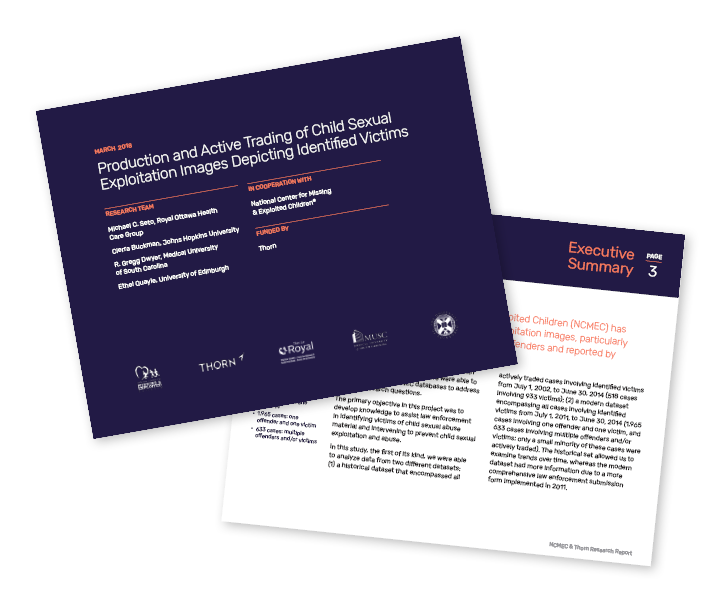
Production and Active Trading of Child Sexual Exploitation Images Depicting Identified Victims

Trends Identified in CyberTipline Sextortion Reports

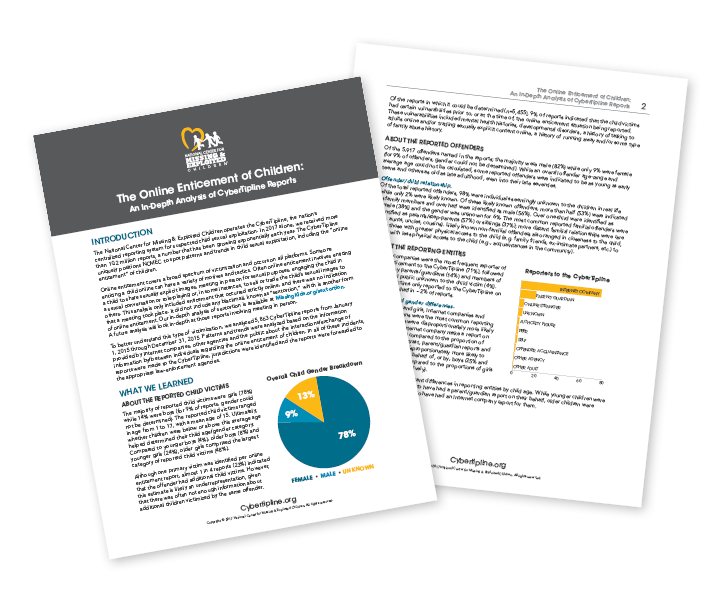
The Online Enticement of Children: An In-Depth Analysis of CyberTipline Reports


National Center for Missing and Exploited Children, CyberTipline, 1-800-843-5678

Report It

If you think you have seen a missing child, or suspect a child may be sexually exploited, contact the National Center for Missing & Exploited Children 24 hours a day, 7 days a week.

Report Child Sexual Exploitation

Use the CyberTipline to report child sexual exploitation.

Make a CyberTipline Report »

The banner is a tool to allow you to conveniently share a link to NCMEC's CyberTipline to create a report. To display this banner on your website:

  • Read the terms of use. Your use of any National Center for Missing & Exploited Children® banner signifies your agreement to these terms of use.
  • Enter the code snippet below into your site.

<iframe src="https://www.missingkids.org/gethelpnow/cybertipline/widget" width="300" height="500"></iframe>


NCMEC is a founding member of


Sunday, April 26, 2026

CyberTipline - NCMEC - Trinity Mount Ministries - REPORT CHILD ABUSE! REPORT CSAM! 1-800-843-5678


2024 marked 40 years of operation for the National Center for Missing & Exploited Children. Over the past four decades, NCMEC has continuously confronted evolving threats against children and worked with law enforcement, legislators, industry, survivors and their families and others to create and implement solutions to keep children safe online.


NCMEC's CyberTipline was created in 1998 to receive reports of suspected child sexual exploitation from the public and electronic service providers (ESPs). Through this work, we support law enforcement efforts to stop child sexual exploitation and abuse and provide services to combat the harmful circulation of child sexual abuse material (CSAM).


This report includes data from reports made to the CyberTipline in 2024 and reflects the ever-changing nature of the threats against children and the landscape of online child protection.

2024 CyberTipline Reports by Electronic Service Providers (ESP) illustration
CyberTipline Media Coverage Success StoriesDownload PDF

Skip to main co         

                  Overview

NCMEC’s CyberTipline is the nation’s centralized reporting system for the online exploitation of children. The public and electronic service providers can make reports of suspected online enticement of children for sexual acts, child sexual molestation, child sexual abuse material, child sex tourism, child sex trafficking, unsolicited obscene materials sent to a child, misleading domain names, and misleading words or digital images on the internet.

Every child deserves a safe childhood.

What Happens to Information in a CyberTip?

NCMEC staff review each tip and work to find a potential location for the incident reported so that it may be made available to the appropriate law-enforcement agency for possible investigation. We also use the information from our CyberTipline reports to help shape our prevention and safety messages.

Is Your Image Out There?

Get Support

One of the worst things about having an explicit image online is feeling like you’re facing everything alone. But you have people who care for you and want to help. Reach out to them!

A trusted adult can offer advice, help you report, and help you deal with other issues. It could be your mom, dad, an aunt, a school counselor, or anyone you trust and are comfortable talking to. You can also “self report” by making a report on your own to the CyberTipline.

Families of exploited children often feel alone in their struggle and overwhelmed by the issues affecting their lives. NCMEC provides assistance and support to victims and families such as crisis intervention and local counseling referrals to appropriate professionals. Additionally, NCMEC’s Team HOPE is a volunteer program that connects families to others who have experienced the crisis of a sexually exploited child.

Don't Give Up

Having a sexually exploitative image of yourself exposed online is a scary experience. It can make you feel vulnerable and isolated, but remember, others have been in the same situation as you – and they’ve overcome it. Learn the steps you can take to limit the spread of the content.

By the Numbers

In 2023, reports made to the CyberTipline rose more than 12% from the previous year, surpassing 36.2 million reports.

There were 105,653,162 data files reported to the CyberTipline in 2023.

Reports of online enticement increased by more than 300% from 44,155 in 2021 to 186,819 in 2023. 

Find more data in the CyberTipline Report.

By the Numbers

In 2022:

Find more data in the CyberTipline Report.

More

Learn more about online exploitation and safety.
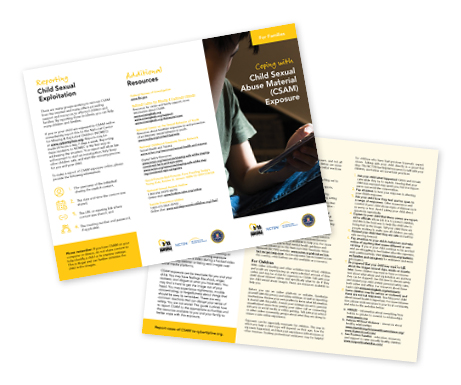
Coping with Child Sexual Abuse (CSAM) Exposure For Families

Production and Active Trading of Child Sexual Exploitation Images Depicting Identified Victims
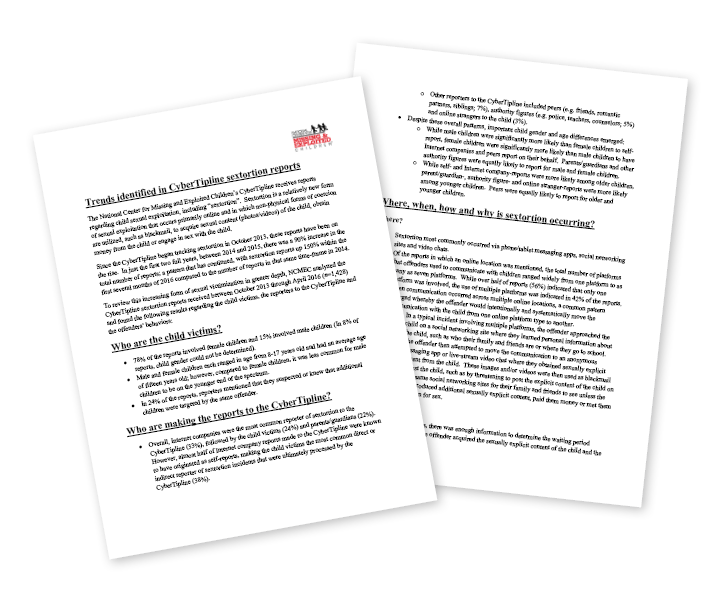
Trends Identified in CyberTipline Sextortion Reports

The Online Enticement of Children: An In-Depth Analysis of CyberTipline Reports


National Center for Missing and Exploited Children, CyberTipline, 1-800-843-5678

Report It

If you think you have seen a missing child, or suspect a child may be sexually exploited, contact the National Center for Missing & Exploited Children 24 hours a day, 7 days a week.

Report Child Sexual Exploitation

Use the CyberTipline to report child sexual exploitation.

Make a CyberTipline Report »

The banner is a tool to allow you to conveniently share a link to NCMEC's CyberTipline to create a report. To display this banner on your website:

  • Read the terms of use. Your use of any National Center for Missing & Exploited Children® banner signifies your agreement to these terms of use.
  • Enter the code snippet below into your site.

<iframe src="https://www.missingkids.org/gethelpnow/cybertipline/widget" width="300" height="500"></iframe>


NCMEC is a founding member of