Trinity Mount Ministries

Showing posts with label Trinity Mount Ministries. Show all posts

Thursday, March 12, 2026

Keeping Your Children Safe in the Age of Social Media: A Parent’s Guide

Know the Apps, Protect Your Kids

Children and teens now use more apps and online platforms than ever. While many support creativity, learning, and connection, others may expose young users to cyberbullying, inappropriate content, privacy risks, or contact with strangers.


Safer Internet Day highlights that awareness, rather than fear, is key to keeping children safe online. Understanding the apps children use and how they work is an essential first step.


Why Knowing the Apps Matters

Many popular apps offer direct messaging, live streaming, location sharing, or anonymous interaction. While these features can be positive when used responsibly, without proper settings and supervision, they may put children at risk. Parents who understand these platforms are better prepared to guide safe online behavior.


Apps Parents Should Be Aware Of Today


Social Media & Photo Sharing


TikTok

A short-form video platform popular with teens. Although parental controls and screen-time tools are available, users may still encounter explicit content, viral challenges, or unwanted interactions if privacy settings are not managed effectively.


Instagram

A photo and video sharing app with Stories, Reels, and private messaging. Risks include cyberbullying, oversharing personal information, unwanted attention, and pressure related to appearance and popularity.


Snapchat

Known for photos and messages that disappear after viewing. However, content can still be saved or shared, and the temporary nature of messages may encourage risky behavior.


BeReal

This app encourages users to post unfiltered photos at random times each day. While it promotes authenticity, it may expose location data and create social pressure to post immediately.


Threads

A text-based social platform linked to Instagram. Similar risks include public posts, unwanted interactions, and oversharing personal information.


Messaging Apps


WhatsApp

A messaging app for texts, photos, videos, and voice messages. While widely used and encrypted, it can enable communication with people outside a child’s known contacts.


Telegram

A messaging platform known for large group chats and strong privacy features. Limited moderation and anonymous interactions may expose minors to inappropriate content or unknown individuals.


Gaming & Live Streaming


Roblox

An online gaming platform where users create and play games made by others. Chat features may expose children to cyberbullying or contact with strangers, and in-game purchases can result in unexpected charges.


Discord

Originally designed for gamers, Discord now hosts many private servers. Unmoderated spaces may expose children to explicit content, bullying, or unsafe interactions.


Twitch

A live streaming platform focused on gaming. Real-time chat features may expose minors to inappropriate language or content.


Bigo Live

A live streaming app that allows users to broadcast and interact in real time. The platform’s gifting and interaction features may encourage risky behavior, especially for minors.


Anonymous & Dating Apps


Yubo

A social discovery app that allows users to connect through live video and chat. Although there are age-based communities, users may misrepresent their age, increasing safety concerns.


Bumble

A dating app for adults that uses location-based matching. Age restrictions exist, but they can be bypassed, potentially exposing minors to inappropriate interactions.


Tinder

A swipe-based dating app that connects nearby users. Its location-based design and adult-focused environment present clear risks for underage users.


LMK (Let Me Know)

An anonymous question and answer app often linked to other social platforms. Anonymity may encourage cyberbullying or inappropriate messaging.


Video Apps


YouTube

YouTube is one of the most widely used platforms among children and teens for entertainment, tutorials, and gaming content. While YouTube and YouTube Kids offer safety tools, users may still encounter videos with inappropriate language, themes, or imagery, and comment sections can expose children to cyberbullying or harmful interactions.


Likee

Likee is a short-form video app similar to TikTok that allows users to create and share edited videos. While less popular than TikTok, it includes public profiles and live features that may expose minors to inappropriate content or unwanted contact with strangers.


A Note on Less-Used or Phased-Out Apps


Some apps that raised concerns in previous years, such as Kik, Ask.fm, Omegle, MeetMe, and Hot or Not, are now far less popular among children and teens or have been phased out. While these platforms may no longer be widely used, they can still exist in limited form or reappear under new names. This underscores the importance of regularly reviewing your child’s device and staying informed as technology evolves.


How Parents Can Help Keep Kids Safe Online

Parents and caregivers play a vital role in online safety. Consider these proactive steps:

  • Have ongoing conversations about online behavior and digital risks
  • Know which apps your child is using and why
  • Set clear rules for screen time and app downloads
  • Enable parental controls and review privacy settings
  • Remind children never to share personal information online
  • Encourage kids to report anything that makes them uncomfortable


Important Disclaimer


This information is provided for educational and awareness purposes only. It is not intended to criticize or discourage the use of any specific app, brand, or developer. Many platforms continue to improve safety tools and protections. Parental involvement, communication, and supervision remain the most effective ways to reduce online risks.

Trusted Government Resources for Online Safety

For additional guidance and reporting tools, parents are encouraged to visit these official resources:


Federal Trade Commission (FTC) – https://www.consumer.ftc.gov

FBI – Internet Crime Complaint Center (IC3) – https://www.ic3.gov

U.S. Department of Justice (DOJ) – https://www.justice.gov

National Center for Missing & Exploited Children (NCMEC) – https://www.missingkids.org

USA.gov – Online Safety for Kids – https://www.usa.gov

If you have any questions about how to keep your child safe online, please contact our office at 407-348-2222.


Saturday, March 7, 2026

CyberTipline - NCMEC - Trinity Mount Ministries - REPORT CHILD ABUSE! REPORT CSAM! 1-800-843-5678


Skip to main co         

                      Overview

NCMEC’s CyberTipline is the nation’s centralized reporting system for the online exploitation of children. The public and electronic service providers can make reports of suspected online enticement of children for sexual acts, child sexual molestation, child sexual abuse material, child sex tourism, child sex trafficking, unsolicited obscene materials sent to a child, misleading domain names, and misleading words or digital images on the internet.

Every child deserves a safe childhood.

What Happens to Information in a CyberTip?

NCMEC staff review each tip and work to find a potential location for the incident reported so that it may be made available to the appropriate law-enforcement agency for possible investigation. We also use the information from our CyberTipline reports to help shape our prevention and safety messages.

Is Your Image Out There?

Get Support

One of the worst things about having an explicit image online is feeling like you’re facing everything alone. But you have people who care for you and want to help. Reach out to them!

A trusted adult can offer advice, help you report, and help you deal with other issues. It could be your mom, dad, an aunt, a school counselor, or anyone you trust and are comfortable talking to. You can also “self report” by making a report on your own to the CyberTipline.

Families of exploited children often feel alone in their struggle and overwhelmed by the issues affecting their lives. NCMEC provides assistance and support to victims and families such as crisis intervention and local counseling referrals to appropriate professionals. Additionally, NCMEC’s Team HOPE is a volunteer program that connects families to others who have experienced the crisis of a sexually exploited child.

Don't Give Up

Having a sexually exploitative image of yourself exposed online is a scary experience. It can make you feel vulnerable and isolated, but remember, others have been in the same situation as you – and they’ve overcome it. Learn the steps you can take to limit the spread of the content.

By the Numbers

In 2023, reports made to the CyberTipline rose more than 12% from the previous year, surpassing 36.2 million reports.

There were 105,653,162 data files reported to the CyberTipline in 2023.

Reports of online enticement increased by more than 300% from 44,155 in 2021 to 186,819 in 2023. 

Find more data in the CyberTipline Report.

By the Numbers

In 2022:

Find more data in the CyberTipline Report.

More

Learn more about online exploitation and safety.

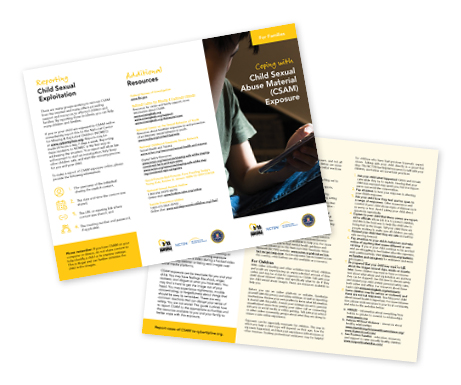
Coping with Child Sexual Abuse (CSAM) Exposure For Families

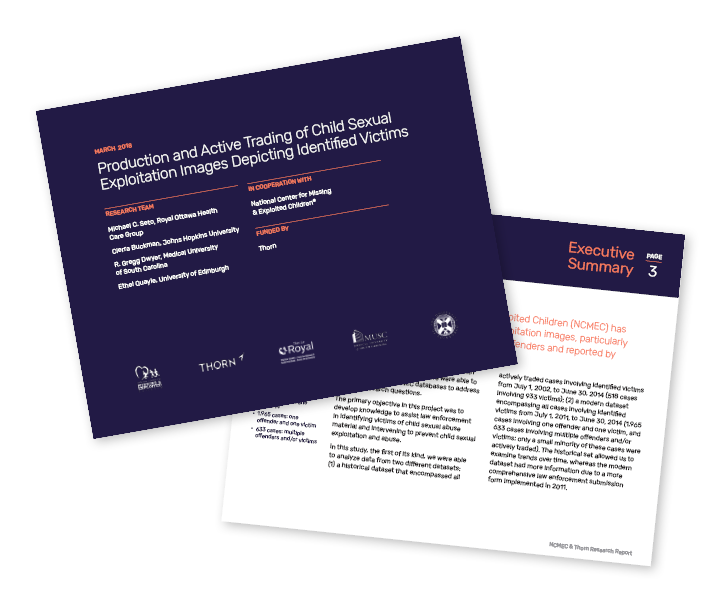
Production and Active Trading of Child Sexual Exploitation Images Depicting Identified Victims

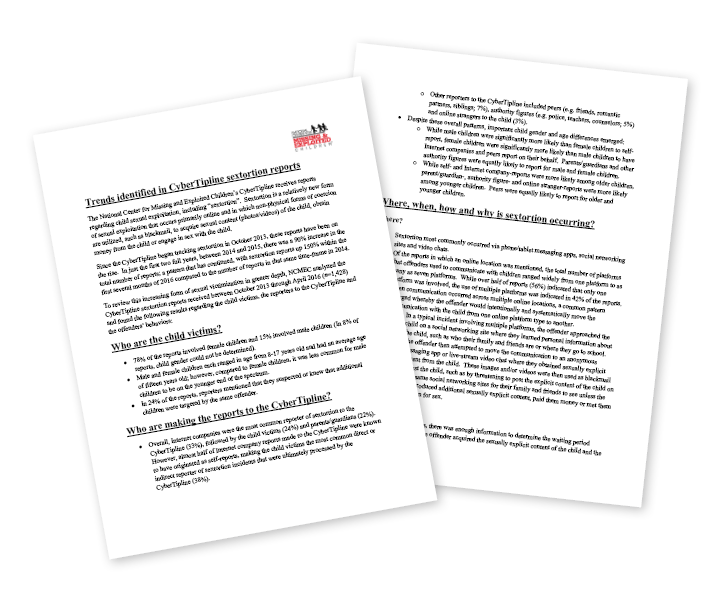
Trends Identified in CyberTipline Sextortion Reports

The Online Enticement of Children: An In-Depth Analysis of CyberTipline Reports


National Center for Missing and Exploited Children, CyberTipline, 1-800-843-5678

Report It

If you think you have seen a missing child, or suspect a child may be sexually exploited, contact the National Center for Missing & Exploited Children 24 hours a day, 7 days a week.

Report Child Sexual Exploitation

Use the CyberTipline to report child sexual exploitation.

Make a CyberTipline Report »

The banner is a tool to allow you to conveniently share a link to NCMEC's CyberTipline to create a report. To display this banner on your website:

  • Read the terms of use. Your use of any National Center for Missing & Exploited Children® banner signifies your agreement to these terms of use.
  • Enter the code snippet below into your site.

<iframe src="https://www.missingkids.org/gethelpnow/cybertipline/widget" width="300" height="500"></iframe>


NCMEC is a founding member of


Tuesday, March 3, 2026

Keeping your kids safe online: The free tools parents need to know


Dangers lurk online and in the video games your kids play for fun. Fortunately, there are some free apps that can help you monitor what your kids are doing and who they are communicating with.


Monday, March 2, 2026

PROJECT SAFE CHILDHOOD - DOJ - Trinity Mount Ministries - UPDATE - 03/11/2026

Help Find Missing Children. Let's Put An End To Child Abuse And Exploitation... Care.

PROJECT SAFE CHILDHOOD

Project Safe Childhood

  
About Project Safe Childhood

Project Safe Childhood is a nationwide initiative to combat the growing epidemic of child sexual exploitation and abuse launched in May 2006 by the Department of Justice.  Led by the U.S. Attorneys' Offices and the Criminal Division's Child Exploitation and Obscenity Section (CEOS), Project Safe Childhood marshals federal, state and local resources to better locate, apprehend and prosecute individuals who exploit children via the Internet, as well as to identify and rescue victims.

Learn More About Project Safe Childhood

Sunday, March 1, 2026

Trinity Mount Ministries - NCMEC - AMBER Alerts - Active Missing Children Posters - UPDATE - 03/11/2026

Help Find Missing Children. Let's Put An End To Child Abuse And Exploitation... Care.


Active Missing Children Posters Below.

Active AMBER Alerts
NameMissing FromIssued ForAlert Date
Allen FischerMonteview, IDIDJun 23, 2025
Rachelle FischerMonteview, IDIDJun 23, 2025


Active AMBER Alert cases will remain on this page updated to 6 months from activation.  Following that, active missing child posters can be found by using the search tool 
here.

Notice: The National Center for Missing & Exploited Children® certifies the posters on this site only if they contain the NCMEC logo and the 1-800-THE-LOST® (1-800-843-5678) number. All other posters are the responsibility of the agency whose logo appears on the poster.