Trinity Mount Ministries

Showing posts with label social media. Show all posts

Friday, May 15, 2026

​The Ninth Circuit's New Roadmap: Navigating the Future of Child Safety Laws


​If you’ve been following the ongoing tug-of-war between tech industry groups and state legislatures over kids' online safety, you know it’s been a chaotic legal battleground. But a recently published report, The Ninth Circuit Provides a Potential Roadmap for Future Child Safety Laws (May 15, 2026), highlights a massive turning point.

​Over the past year, the Ninth Circuit Court of Appeals has issued a series of decisions—most notably in NetChoice v. Bonta regarding the California Age-Appropriate Design Code Act (CAADCA)—that dismantle the idea of broad tech immunity. Instead of striking down child safety laws in their entirety, the court has provided a clear, constitutional roadmap for how lawmakers can protect children online without running afoul of the First Amendment.

​Here is a breakdown of the key takeaways from the Ninth Circuit's recent rulings and what they mean for the future of digital regulation.

​1. "Audience" Does Not Equal "Content"

​One of the tech industry’s primary defense strategies has been to claim that any law regulating online platforms is a "content-based" restriction, which would subject the law to strict First Amendment scrutiny. The Ninth Circuit rejected this argument for broad safety laws.

​The court clarified that a law applying to businesses "likely to be accessed by children" is not inherently content-based. Regulating a platform based on its audience composition relies on data and demographics, not on the specific viewpoints or nature of the posts being published. This distinction gives lawmakers the green light to craft safety and privacy obligations geared specifically toward younger users.

​2. Age Estimation is Not Inherently Unconstitutional

​Perhaps the biggest win for online safety advocates is the court’s stance on age estimation. The tech industry heavily argued that forcing platforms to estimate users' ages would suppress free speech.

​The Ninth Circuit disagreed, noting that the purpose of the age estimation matters. In the case of the CAADCA, the goal of age estimation is to trigger baseline privacy and data protections—not to restrict access to lawful content. Because businesses can choose to simply default to high privacy settings for all users rather than verify ages, the court found that age estimation, when used for data protection, does not automatically violate the First Amendment.

​3. Specificity is the Ultimate Requirement

​While the Ninth Circuit gave the green light to several regulatory concepts, it also issued a stark warning: vague laws will not survive.

​The court upheld the injunction against several provisions of the CAADCA because they relied on highly subjective language. Terms prohibiting tech companies from using data in ways that are "materially detrimental" to a child or requiring actions to be in the "best interests of children" were struck down for being unconstitutionally vague. The court noted that these phrases fail to give businesses fair notice of what specific conduct is actually prohibited (e.g., does "detrimental" include sleep loss or hurt feelings?).

​What This Means for the Future

​The Ninth Circuit’s recent rulings effectively split the difference, showing that online safety and the First Amendment can coexist. Moving forward, state and federal lawmakers have a distinct playbook to follow:

  • Focus on Design and Privacy: Laws that mandate high default privacy settings, data minimization, and transparency are much more likely to survive legal challenges than laws that try to dictate what content minors can see.
  • Draft with Precision: Legislators must avoid broad, aspirational language like "well-being" or "best interests." Future bills will need to specifically outline the exact technical actions, data usages, and dark patterns that are prohibited.

  • Age-Appropriate Settings Are Here to Stay: With parts of the CAADCA now enforceable, tech companies operating in California (and likely soon elsewhere) will have to provide high-level default privacy settings, obvious monitoring signals, and age-appropriate policy disclosures.

​The Bottom Line

​The "Wild West" era of the internet is slowly being fenced in, but the courts are demanding that the fences be built with constitutional precision. The Ninth Circuit has proven that tech industry groups can no longer rely on sweeping, generalized First Amendment arguments to invalidate entire safety statutes. For advocates and lawmakers, the roadmap is clear: focus on privacy, target the product design, and above all, be specific. 

National Organizations for Child Safety

​If you want to report a missing child, suspected child exploitation, or get involved with advocacy on a larger scale, you can contact these organizations:

​#### National Center for Missing & Exploited Children (NCMEC)

  • 24-Hour Hotline / CyberTipline: 1-800-THE-LOST (1-800-843-5678)

  • Report Online: You can submit a tip at report.cybertip.org or cybertipline.com.
  • Volunteer Email: volunteer@ncmec.org

  • Training Staff Email: training@ncmec.org
  • Ways to Get Involved: You can become an NCMEC Ambassador, sign up for the ADAM Program to receive alerts in your area, participate in events, or donate.

​#### Federal Bureau of Investigation (FBI)

  • General Tips: Contact the FBI online at tips.fbi.gov.

  • Immediate Danger: Call 911. You can also contact your local FBI field office or international office immediately regarding a missing child.

​#### Homeland Security Investigations (HSI)

  • Tip Line: 1-866-DHS-2-ICE (1-866-347-2423)

  • Report Online: ice.gov/tips

​#### Other Helpful Resources

  • ChildHelp National Child Abuse Hotline: 1-800-4-A-CHILD (1-800-422-4453) or visit childhelp.org/hotline.

  • National Center for Victims of Violent Crime (Victim Connect): 1-855-4VICTIM (1-855-484-2846) or visit victimsofcrime.org.

  • Office for Victims of Crime (OVC): 1-800-851-3420 or visit ovc.ojp.gov.

Brett Fletcher / Trinity Mount Ministries 

Contact information:

Email - trinitymount@gmail.com

Phone - (408) 991-4067 (Leave Voicemail)

Trinity Mount Ministries Facebook Profile

https://www.facebook.com/TrinityMountMinistries

Trinity Mount Ministries Facebook Page

https://www.facebook.com/TrinityMount

Trinity Mount Ministries Blog

https://www.TrinityMountMinistries.com

Trinity Mount Ministries on X (Twitter)

https://x.com/TrinityMount


Tuesday, May 5, 2026

Caught in the Algorithm: When Child Advocacy Triggers Social Media Suspensions


By Brett Fletcher 

​The digital frontlines of child protection are complex, constantly shifting, and heavily guarded—as they should be. Social media platforms carry a massive responsibility to police their networks for predatory behavior and illegal content. To do this at scale, they rely heavily on automated algorithms and aggressive safety protocols.

​Usually, this is a good thing. We want platforms to err on the side of caution when it comes to the safety of the vulnerable. But recently, we experienced firsthand what happens when those automated safety nets cast a little too wide of a net.

​Without warning, our X (formerly Twitter) account was suspended.

​For an organization dedicated to finding missing children and providing advocacy for exploited children, suddenly losing access to a primary communication channel is jarring. Information moves at lightning speed in our line of work. A delay in sharing a missing child flyer or an update on an international law enforcement operation can feel agonizing.

​After an appeal, the account was restored—though we are currently navigating the standard 48-hour waiting period for full functionality to return.

​This brief digital exile highlighted a unique paradox that legitimate child advocates face online. The algorithms designed to flag malicious actors are often triggered by the very terminology we use to fight them. When we discuss the realities of exploitation, share updates on law enforcement stings, or use specific keywords to educate the public, we inadvertently trip the wire.

​We become "friendly fire" in the algorithmic war against exploitation.

​Is it frustrating? Absolutely. But looking at the bigger picture, it is a side effect of a system that is trying—however imperfectly—to do the right thing. If an overly sensitive algorithm occasionally inconveniences an advocate but successfully blocks a predator, that is a trade-off we can survive.

​The heart of Trinity Mount Ministries has never been a single social media account. The true impact

 of this work relies entirely on our incredible community of online supporters. You are the ones who share the alerts, read the updates, and keep the awareness alive, even when the algorithms get confused.

​We will be back to full digital strength shortly. Until then, the work doesn't stop. The mission remains, the advocacy continues, and our community stands strong—algorithm or no algorithm.

Thank you for continuing to support Trinity Mount Ministries. We truly appreciate it.

Brett Fletcher - Founder of Trinity Mount Ministries 


Saturday, April 25, 2026

Parents push Congress to act on kids’ online safety after juries find Meta and YouTube liable for harm


Thursday, April 9, 2026

The Grimm Reality of the Feed: How Social Media Architecture Leaves Youth Vulnerable

By Brett Fletcher

It is no secret that modern childhood and young adulthood have shifted into the digital realm. But when we see young people endlessly scrolling through social media or participating in baffling, reckless trends, it is easy to dismiss it as a lack of discipline. The truth is far more complex, and in some corners of the internet, far darker.

​Young users are not just making isolated poor choices; they are navigating highly engineered digital environments that actively exploit their developmental vulnerabilities. And when those vulnerabilities are exposed, organized predators are waiting in the shadows.

​To understand the danger, we have to look at the machinery driving these platforms and the digital underworld that capitalizes on it.

​The Architecture of Attention: The Hook

​Social media platforms are not passive tools; they are active environments powered by AI designed to maximize engagement. They analyze every click, pause, and interaction to curate a personalized "filter bubble" that constantly offers novel stimuli.

​This relies heavily on a variable reward system. Much like a slot machine, the delivery of content and notifications is unpredictable. This triggers continuous dopamine releases, compelling young users to keep scrolling because the "next" video or post might be the one that provides a massive hit of entertainment. Over time, this leads to reduced reward sensitivity, creating a behavioral loop that is incredibly difficult to break.

​The Validation Loop: The Trap

​Adolescence is a period naturally driven by identity formation, social comparison, and the need for peer acceptance. These apps digitize and amplify that process to an unrealistic degree.

​Likes, views, and follower counts become tangible metrics for social standing. When the algorithm rewards extreme, sensational, or boundary-pushing content with high visibility, it implicitly teaches young users that making bad, risky decisions is exactly the behavior required to be "seen" and valued by their peers.

​The Impulsivity Engine: The Fallout

​This digital environment collides directly with human biology. The adolescent brain is still maturing. The amygdala—which processes immediate emotion and impulses—is highly active, while the prefrontal cortex—responsible for long-term planning, impulse control, and risk assessment—is still under construction.

​When you combine a highly stimulated emotional center with an undeveloped braking system, you get profound impulsivity. This manifests as "stress posting" in the heat of the moment, sharing inappropriate images, or engaging in risky viral trends simply because they see those behaviors heavily endorsed online.

​Unfortunately, these impulsive moments of poor judgment are exactly what digital predators use as bait.

​The Digital Underworld: A Modern Grimm Tale

​At the fringes of mainstream social media, organized predatory groups actively hunt for vulnerable, isolated youth. This is where the platform architecture turns from a behavioral trap into a genuine, true-crime nightmare.

  • The Weaponization of the Taboo: Networks like the notorious "764" group often cloak themselves in dark, "demonic," or extreme occult aesthetics. This branding is not a genuine religious movement; it is a calculated psychological weapon. It is designed to project absolute power, exploit a young person's natural fascination with the taboo, and terrify them into submission.
  • Coercion and Control: Predators gather compromising material by catfishing targets, using social engineering, or simply saving the impulsive posts a young person regrets. They then use brutal extortion tactics to force the youth into a corner, threatening to ruin their lives or harm their families if they do not comply.
  • The Gamification of Cruelty: Once control is established, the demands escalate. These networks operate on a twisted hierarchy where members gain status by forcing their young victims to commit terrible acts. This can range from producing abusive material to committing real-world self-harm or violence.
  • The Wall of Silence: Because the victim feels intense shame about how they were trapped, and genuine terror of the group's artificially inflated "demonic" power, they rarely reach out to authorities. The algorithmic design of platforms keeps this entire ordeal hidden in direct messages and encrypted chats, entirely invisible to the adults in the room.

​Breaking the Silence


These groups are not supernatural forces; they are highly organized criminals exploiting the exact psychological vulnerabilities that modern apps amplify. By understanding the intersection of platform design, adolescent psychology, and digital extortion, we can move past the standard "screen time" debate.

​Protecting our youth requires recognizing that the digital world has real-world consequences, and the first step in dismantling these predatory networks is pulling their tactics out of the shadows and into the light.


Sunday, April 5, 2026

The Ghost in the Machine: How Social Media Algorithms Actually Work

Brett Fletcher 

At its simplest, an algorithm is just a recipe.

​If you’re baking a cake, the recipe tells you exactly what to do to get a specific result. In the world of social media, the "result" the platform wants is your attention. The algorithm is a set of mathematical rules that looks at everything you do—what you like, how long you pause on a photo, and even what you search for—to decide what to show you next.

​It’s Not "Content," It’s "Data"

​Every time you interact with a post, you are training the algorithm. It tracks:

  • Engagement: Did you like, comment, or share?
  • Watch Time: Did you watch the whole video or skip it?
  • Relevance: Does this post match the topics you’ve looked at before?

​The goal isn't necessarily to show you the "best" content; it’s to show you the content most likely to keep you from closing the app.

​The Danger Zone: Why This is Risky for Children

​For adults, algorithms can be annoying. For children and teenagers, they can be dangerous. Because a child’s brain—specifically the prefrontal cortex, which handles impulse control—isn't fully developed until their mid-20s, they are uniquely vulnerable to algorithmic manipulation.

  1. The Rabbit Hole Effect: If a child clicks on one video about a diet, the algorithm may start flooding their feed with extreme fitness or "thinspiration" content. This can lead to body dysmorphia or eating disorders.
  2. Echo Chambers: Algorithms show us more of what we already believe. For a child, this can lead to radicalization or the spread of misinformation, as they are never challenged by a different point of view.
  3. Validation Addiction: The "Like" button acts as a social scorecard. When the algorithm hides a post or it doesn't perform well, children often internalize this as a personal failure or social rejection.

​The "Infinite Scroll": A Trap by Design

​Have you ever noticed that social media feeds never actually end? This is called the Infinite Scroll, and it is one of the most effective psychological "hacks" ever created.

​1. The Slot Machine Effect

​Algorithms use something called Variable Ratio Reinforcement. This is the same logic used in gambling. You scroll through three boring posts, and then—BAM—a funny cat video or a post from a crush. That tiny hit of dopamine keeps you scrolling, hoping the next "win" is just one flick of the thumb away.

​2. Removing "Stopping Cues"

​In the old days of the internet, you had to click "Next Page." That click was a stopping cue—a tiny moment for your brain to ask, "Do I really want to keep doing this?" By removing pages and making the feed infinite, social media sites bypass your conscious brain, keeping you in a "flow state" where time seems to disappear.

​3. Artificial Urgency (FOMO)

​Algorithms often show you things "out of order" to create a sense of urgency. By highlighting what's "trending" or "happening now," they trigger the Fear Of Missing Out (FOMO), making you feel like if you stop scrolling, you’ll be left behind by your social circle.

​How to Fight Back

​You don’t have to delete your accounts to stay safe. Try these three steps:

  • Turn off "Autoplay": Don't let the app decide when the next video starts.
  • Set Time Limits: Use the "Screen Time" settings on your phone to hard-stop your usage.
  • Reset Your Algorithm: Periodically go into your settings and clear your "Interested" or "Search" history to give the machine a fresh start.


Thursday, March 12, 2026

Keeping Your Children Safe in the Age of Social Media: A Parent’s Guide


Know the Apps, Protect Your Kids

Children and teens now use more apps and online platforms than ever. While many support creativity, learning, and connection, others may expose young users to cyberbullying, inappropriate content, privacy risks, or contact with strangers.


Safer Internet Day highlights that awareness, rather than fear, is key to keeping children safe online. Understanding the apps children use and how they work is an essential first step.


Why Knowing the Apps Matters

Many popular apps offer direct messaging, live streaming, location sharing, or anonymous interaction. While these features can be positive when used responsibly, without proper settings and supervision, they may put children at risk. Parents who understand these platforms are better prepared to guide safe online behavior.


Apps Parents Should Be Aware Of Today

Social Media & Photo Sharing


TikTok

A short-form video platform popular with teens. Although parental controls and screen-time tools are available, users may still encounter explicit content, viral challenges, or unwanted interactions if privacy settings are not managed effectively.


Instagram

A photo and video sharing app with Stories, Reels, and private messaging. Risks include cyberbullying, oversharing personal information, unwanted attention, and pressure related to appearance and popularity.


Snapchat

Known for photos and messages that disappear after viewing. However, content can still be saved or shared, and the temporary nature of messages may encourage risky behavior.


BeReal

This app encourages users to post unfiltered photos at random times each day. While it promotes authenticity, it may expose location data and create social pressure to post immediately.


Threads

A text-based social platform linked to Instagram. Similar risks include public posts, unwanted interactions, and oversharing personal information.


Messaging Apps


WhatsApp

A messaging app for texts, photos, videos, and voice messages. While widely used and encrypted, it can enable communication with people outside a child’s known contacts.


Telegram

A messaging platform known for large group chats and strong privacy features. Limited moderation and anonymous interactions may expose minors to inappropriate content or unknown individuals.


Gaming & Live Streaming


Roblox

An online gaming platform where users create and play games made by others. Chat features may expose children to cyberbullying or contact with strangers, and in-game purchases can result in unexpected charges.


Discord

Originally designed for gamers, Discord now hosts many private servers. Unmoderated spaces may expose children to explicit content, bullying, or unsafe interactions.


Twitch

A live streaming platform focused on gaming. Real-time chat features may expose minors to inappropriate language or content.


Bigo Live

A live streaming app that allows users to broadcast and interact in real time. The platform’s gifting and interaction features may encourage risky behavior, especially for minors.


Anonymous & Dating Apps


Yubo

A social discovery app that allows users to connect through live video and chat. Although there are age-based communities, users may misrepresent their age, increasing safety concerns.


Bumble

A dating app for adults that uses location-based matching. Age restrictions exist, but they can be bypassed, potentially exposing minors to inappropriate interactions.


Tinder

A swipe-based dating app that connects nearby users. Its location-based design and adult-focused environment present clear risks for underage users.


LMK (Let Me Know)

An anonymous question and answer app often linked to other social platforms. Anonymity may encourage cyberbullying or inappropriate messaging.


Video Apps


YouTube

YouTube is one of the most widely used platforms among children and teens for entertainment, tutorials, and gaming content. While YouTube and YouTube Kids offer safety tools, users may still encounter videos with inappropriate language, themes, or imagery, and comment sections can expose children to cyberbullying or harmful interactions.


Likee

Likee is a short-form video app similar to TikTok that allows users to create and share edited videos. While less popular than TikTok, it includes public profiles and live features that may expose minors to inappropriate content or unwanted contact with strangers.


A Note on Less-Used or Phased-Out Apps


Some apps that raised concerns in previous years, such as Kik, Ask.fm, Omegle, MeetMe, and Hot or Not, are now far less popular among children and teens or have been phased out. While these platforms may no longer be widely used, they can still exist in limited form or reappear under new names. This underscores the importance of regularly reviewing your child’s device and staying informed as technology evolves.


How Parents Can Help Keep Kids Safe Online

Parents and caregivers play a vital role in online safety. Consider these proactive steps:

  • Have ongoing conversations about online behavior and digital risks
  • Know which apps your child is using and why
  • Set clear rules for screen time and app downloads
  • Enable parental controls and review privacy settings
  • Remind children never to share personal information online
  • Encourage kids to report anything that makes them uncomfortable


Important Disclaimer


This information is provided for educational and awareness purposes only. It is not intended to criticize or discourage the use of any specific app, brand, or developer. Many platforms continue to improve safety tools and protections. Parental involvement, communication, and supervision remain the most effective ways to reduce online risks.

Trusted Government Resources for Online Safety

For additional guidance and reporting tools, parents are encouraged to visit these official resources:


Federal Trade Commission (FTC) – https://www.consumer.ftc.gov

FBI – Internet Crime Complaint Center (IC3) – https://www.ic3.gov

U.S. Department of Justice (DOJ) – https://www.justice.gov

National Center for Missing & Exploited Children (NCMEC) – https://www.missingkids.org

USA.gov – Online Safety for Kids – https://www.usa.gov

If you have any questions about how to keep your child safe online, please contact our office at 407-348-2222.


Thursday, March 27, 2025

@elonmusk by Brett Fletcher @TrinityMount


NOTE - This is a Trinity Mount Ministries blog entry from December 4, 2022. I decided to repost it.

@elonmusk

I think it is hilarious how the world of social media seems very upset since the brilliant and wealthy man, Elon Musk, purchased Twitter! "That’s it! I'm leaving Twitter!" Twitter is ruined!" "Advertisers are leaving Twitter!" Etc., ad nauseum!

The only thing I know: When I founded Trinity Mount Ministries back in 2011, the two main social media platforms that would be instrumental for the cause of sharing information about Missing and exploited children, related news articles and child safety content would be Twitter and Facebook. Now, as we are approaching 2023, (12 years later) this remains true. No other social media platforms comes close to the combination of Twitter and Facebook, in relation to Trinity Mount Ministries, Trinity Mount Global Missing Kids and Trinity Mount International Missing Kids. 

So, leave these platforms if you must... I will continue to utilize these valuable tools for the above-mentioned cause: helping to find missing and exploited children, domestically and internationally, as well as promoting child safety. I hardly think Elon Musk or Mark Zuckerberg are too concerned about anybody's departure(s) from their social media platforms. My guess - these two platforms will do whatever necessary to stay afloat. 

The only difference I've noticed on Twitter: it's interesting and even exciting to some extent. I've always believed and maintain this to be true: if you don't like what someone shares: ignore it, fight against it, block it, protest it... though, a platform is there for you to use as well, as you see fit...to some extent. I believe in moderation as well as free speech. They can co-exist... when clear, cool and sound heads prevail. 

Brett Fletcher, Founder of Trinity Mount Ministries 

@TrinityMount https://www.twitter.com/TrinityMount


Friday, February 7, 2025

The Kids Off Social Media Act Misses the Mark on Children’s Online Safety


February 6, 2025

As part of the ongoing debate surrounding children’s online safety, Senators Ted Cruz (R-TX), Brian Schatz (D-HI), Chris Murphy (D-CT), and Katie Britt (R-AL) reintroduced the Kids Off Social Media Act (KOSMA), which the Senate Commerce Committee advanced on February 5, 2025. The bill would prohibit users under the age of 13 from using social media entirely, prohibit recommendation algorithms for users under the age of 17, and require schools to restrict social media access on federally funded networks. Like other recent children’s online safety bills, KOSMA has many flaws, namely that it complicates compliance for platforms that already disallow children below age 13 and limits users’ ability to fully customize their online experience.

In a statement on the bill, Sen. Cruz outlined his intentions for KOSMA: To “combat the harms social media poses to children,” including predatory adults, content that promotes risky behavior, and content that negatively affects children’s self-esteem. Everyone, including social media platforms themselves, can agree that certain online content or activities can negatively impact children. However, social media also has many benefits for children and teens, such as facilitating communication, education, entertainment, and community-building. Like other children’s online safety bills, KOSMA fails to balance reducing the risk of harm with magnifying the benefits of social media.

KOSMA rightfully observes that all the major social media platforms already prohibit children under the age of 13. Online services restrict these users because the Children’s Online Privacy Protection Act (COPPA) imposes additional requirements on platforms with users under the age of 13. At the same time, KOSMA does not require platforms to use age verification to ensure they have no users below age 13. As a result, this bill accomplishes nothing that platforms do not already do in terms of restricting young children from their services.

However, KOSMA creates a regulatory challenge for social media platforms. With regard to underage users, COPPA holds platforms to an “actual knowledge” standard—online services are obligated to act when they are aware and have no doubt that a minor under the age of 13 uses the service. But KOSMA uses a “reasonable knowledge” standard—online services must act if there is a high likelihood that a user is below the age of 13. COPPA’s actual knowledge standard allows online services to protect children without significantly increasing compliance costs, whereas KOSMA’s reasonable knowledge standard is so broad and ill-defined that it would raise compliance costs and subject platforms to an increased risk of liability, even when attempting to comply in good faith.

KOSMA also prohibits personalized recommendation systems for users under the age of 17. Social media users should be able to choose the experiences they prefer, whether that be chronological feeds or algorithmic ones that prioritize content based on users’ profiles. Indeed, many platforms already give users this choice, and most users prefer personalized recommendation systems. Banning these systems would cut children and teenagers off from the benefits of algorithmic feeds, which recommend content users are more likely to find interesting and make it much easier for users to discover new content.

KOSMA does include exceptions for social media platforms to use certain, very limited types of data to personalize children’s feeds, but this does not include important data such as children’s interests or content they have interacted with in the past. Ultimately, KOSMA assumes personalized recommendations are always harmful, meaning these rules would also prohibit social media sites from creating customized feeds that could boost positive content encouraging acts of kindness, self-care, educational curiosity, and healthy living habits.

Though it attempts to differentiate itself from other children’s online safety bills, ultimately this bill is more of the same, with many of the same problems present in other proposals. KOSMA complicates platforms’ compliance and limits users’ ability to customize their experience. Additionally, because it does not preempt state law, KOSMA will further muddy the waters in the conflicting patchwork of state laws in the United States. KOSMA—and other children’s online safety bills up for debate—needs further improvement before Congress passes children’s online safety legislation.

Instead of resorting to blanket bans or proposals that target core features of social media such as algorithmsCongress should pass legislation to establish a standardized child-flag system, giving parents and guardians greater control over their children’s online safety. Under this system, all users would be presumed adults unless marked as children, with platforms checking for this flag when accessing age-restricted content. This approach would be less burdensome for platforms, parents, children, and adult social media users, and would strike a better balance between enabling children and teens to access the benefits of online spaces while gatekeeping them from inappropriate content.


Wednesday, September 13, 2023

Facebook Continues To Block, Restrict And Suppress Trinity Mount Ministries - Part II


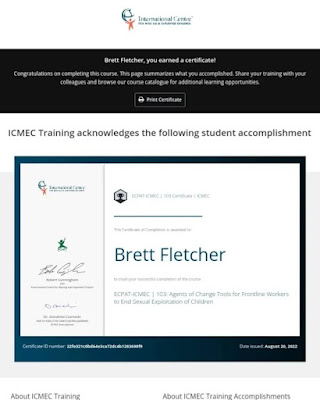
 Image: ECPAT-ICMEC | 103 Certificate | ICMEC
This Certificate of Completion is awarded to: Brett Fletcher to mark your successful completion of the course: ECPAT-ICMEC | 103: Agents of Change Tools for Frontline Workers to End Sexual Exploitation of Children.

Being on #Facebook is becoming anti-productive with all of the negative attacks on the content that Trinity Mount Ministries shares, which focuses on helping missing and exploited children. I'm in the process of dedicating more time on X (Twitter), that doesn't discriminate against Trinity Mount Ministries. As my activity decreases on Facebook, it will increase on X (Twitter). Please follow. 👍❤️🙏

Brett Fletcher - Founder of Trinity Mount Ministries 

Trinity Mount Ministries on X (Twitter)


Trinity Mount Ministries 


Thursday, September 7, 2023

Facebook Continues To Block, Restrict And Suppress Trinity Mount Ministries

By Brett Fletcher - Founder of Trinity Mount Ministries


Image: ECPAT-ICMEC | 103 Certificate | ICMEC - 
This Certificate of Completion is awarded to: Brett Fletcher to mark your successful completion of the course: ECPAT-ICMEC | 103: Agents of Change Tools for Frontline Workers to End Sexual Exploitation of Children.

Facebook Admin continues to block, restrict and suppress Trinity Mount Ministries from:

1. Sharing AMBER Alerts and updates.

2. Sharing child safety information.

3. Sharing missing children posters and updates.

4. Sharing police and public safety alerts and updates. 

4. Sharing Community events and services.

5. Sharing posts of faith and inspiration. 

6. Sharing news articles and reports.

Facebook treats their users as if they were little children, attempting to punish their disobedience with restrictions and time outs. I've been to Facebook HQ several times for paid research sessions, being surprised by how young the Facebook staff and employees were, which might explain their rules, policies and procedures and how they are implemented. Their disciplinary actions cause laughter, anger and disbelief. 

In order to maintain their control over free speech and/or anything that goes against their agenda - blocking, restricting and suppression[a] are their modus operandi.[b] Facebook is not in the business of respecting people's rights and can block, restrict, suppress or remove anything that they want to without any repercussions. That is just they way their culture is and I accept that. Nevertheless, my hope is that Facebook Admin might read this without bias, recognizing what type of content they are blocking, restricting and/or suppressing (such as posts to help and protect missing and exploited children), and reconsider some of their policies that cause more harm than help.

Brett Fletcher - Founder of Trinity Mount Ministries 

[a] the action of suppressing something such as an activity or publication.

[b] a particular way or method of doing something, especially one that is characteristic or well-established.

Trinity Mount Ministries

https://www.TrinityMountMinistries.com

https://www.TrinityMount.Info